Soil Monitoring & Soil Hydrology
Soil Monitoring
- Soil Types
- Soil Water Potential
- Soil Water Percentage
- Soil chemistry (some of which can be done with an in-situ sensor, and some by lab analysis)

Advanced Soil Measurement Overview Purpose:
Understanding soil conditions and water movement below the surface is critical for agriculture, water resources, engineering, climatological studies, and environmental research. Soil moisture, salinity, temperature, density, matrix potential, soil water quality, and hydraulic properties directly influence turf & crop performance, irrigation efficiency, slope stability, and groundwater recharge. Stevens provides accurate, research-grade soil monitoring solutions that enable users to characterize the soil profile, quantify water availability, and understand how water moves through the vadose zone over time.
Climate Impact. Soil is an important natural resource, just as the air and water that surround us are. Unfortunately, it has been overlooked in the past and taken. Today, soil health and soil hydrology on our climate is taken more seriously improving our understanding how soil interacts with the rest of our environment and climate, with researchers at organizations such as
· Soil Climate Analysis Network (SCAN)
· US Department of Agriculture (USDA)
· International Soil Moisture Network (ISMN)
· Long Term Ecological Research Network (LTER)
· Critical Zone Observatories (CZO / CZNet)
· U.S. Climate Reference Network (USCRN)
· FLUXNET
· National Ecological Observatory Network (NEON)
· Many universities
In addition to soil conditions influence on our climate, soil monitoring is increasingly imported in agriculture and turf management. Irrigation of crops / turf represents 90% of the water used worldwide. Monitoring soil moisture in the root zone of crops will optimize irrigation. The benefits of optimizing irrigation scheduling that are crop / turf specific with soil moisture sensors includes increasing crop yields, saving water, protecting local water resources from runoff, saving on energy costs, saving on fertilizer costs and increasing the farmer profitability. Erosion (including landslides) from changes in land use causes millions of dollars in damage to property and natural water systems. In order to understand the causes of erosion and make predictions about when and where erosion will occur, hydrologists need to record rainfall, sediment, and soil moisture. Understanding the soil type and water infiltration rate of soil is a function of soil moisture. If the soil is dry, the infiltration rate will be sufficient to prevent it from run off. Overland water flow may occur if rain events happen at a time when soil is saturated. Monitoring soil moisture is an important input parameter into erosion prediction models.
Engineering. Soil hydrology measurement is fundamental to civil and geotechnical engineering because it governs how water is stored, moves, and influences soil strength, deformation, and stability. Parameters such as soil moisture content, matric (matrix) potential, hydraulic conductivity, infiltration rate, and groundwater level directly affect effective stress, bearing capacity, settlement, and slope stability. In applications including foundations, embankments, slopes, roadways, dams, and retaining structures, excess pore water pressure or changing moisture conditions can lead to failures such as slope instability, consolidation settlement, shrink–swell behavior, or frost heave. By combining in-situ soil condition monitoring with process-based hydrologic measurements, engineers can design safer structures, optimize drainage and mitigation strategies, reduce overengineering, and meet regulatory and environmental requirements with defensible data.
Stevens soil monitoring and soil hydrology systems support applications ranging from routine field measurements to long-term scientific and regulatory studies. These solutions are used for irrigation management, crop / turf management, watershed and groundwater investigations, engineering analysis, and sensor validation and calibration. Supported by proven instrumentation, including reference-grade tools from SoilMoisture Equipment Corp, Stevens delivers defensible soil data that integrates seamlessly with broader water and environmental monitoring programs.
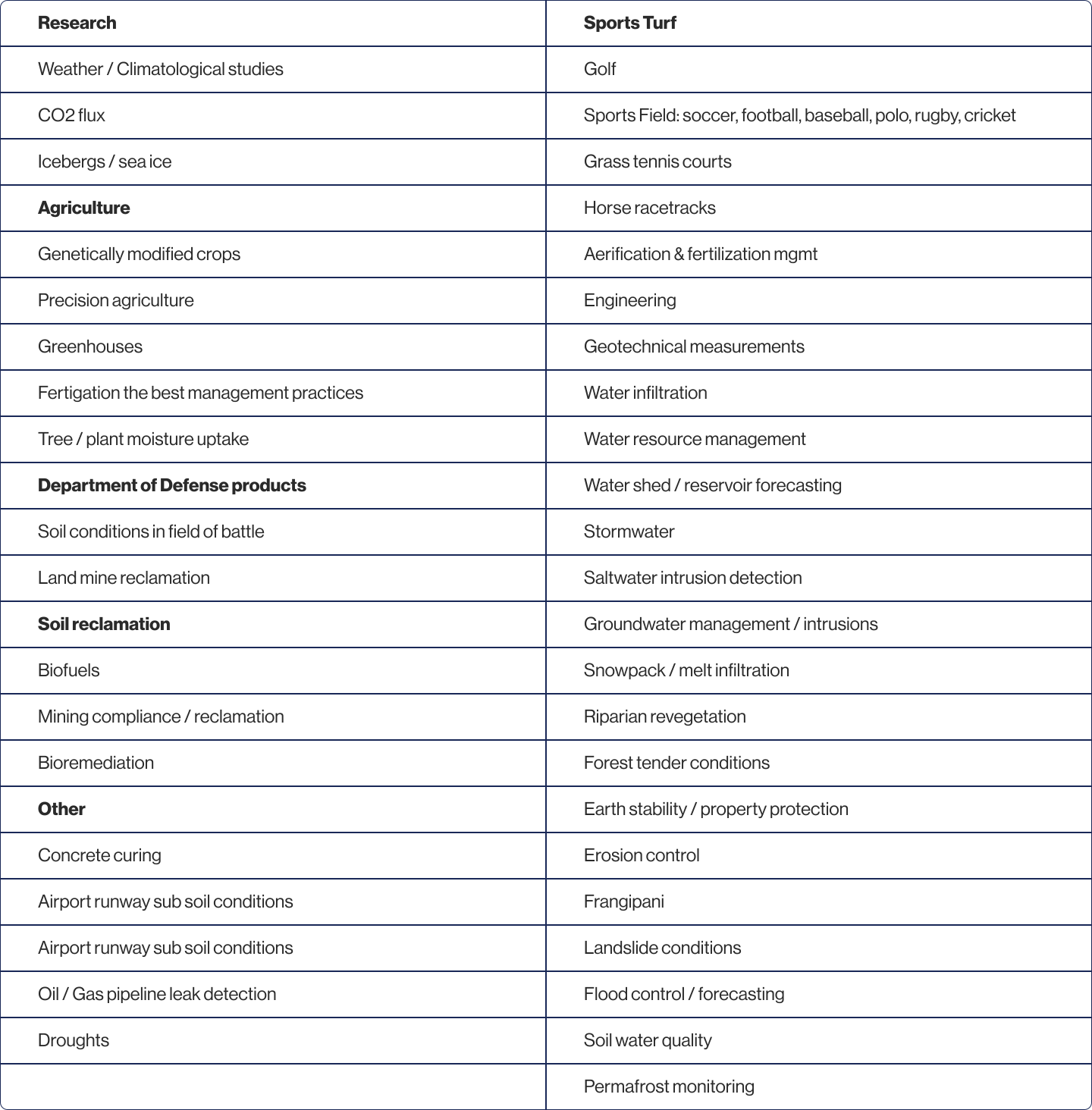
Applications
RM 1805 Unit 3, Jinquanshidai
Datun, Chaoyang District
Beijing 100101 China
Applications
Soil Sensors – permanent
Employer: Stevens Water Monitoring Systems, Inc.Job Location: Portland, OregonTitle: Senior Embedded Systems IoT Hardware Design Engineer Duties: Requirements: Bachelor’s degree or equivalent in Electrical Engineering,
Soil Sensors – portable
Employer: Stevens Water Monitoring Systems, Inc.Job Location: Portland, OregonTitle: Senior Embedded Systems IoT Hardware Design Engineer Duties: Requirements: Bachelor’s degree or equivalent in Electrical Engineering,
Infiltrometers/ Permeameters
Employer: Stevens Water Monitoring Systems, Inc.Job Location: Portland, OregonTitle: Senior Embedded Systems IoT Hardware Design Engineer Duties: Requirements: Bachelor’s degree or equivalent in Electrical Engineering,
Soil Sensors – permanent
Employer: Stevens Water Monitoring Systems, Inc.Job Location: Portland, OregonTitle: Senior Embedded Systems IoT Hardware Design Engineer Duties: Requirements: Bachelor’s degree or equivalent in Electrical Engineering,
Soil Sensors – portable
Employer: Stevens Water Monitoring Systems, Inc.Job Location: Portland, OregonTitle: Senior Embedded Systems IoT Hardware Design Engineer Duties: Requirements: Bachelor’s degree or equivalent in Electrical Engineering,
Infiltrometers/ Permeameters
Employer: Stevens Water Monitoring Systems, Inc.Job Location: Portland, OregonTitle: Senior Embedded Systems IoT Hardware Design Engineer Duties: Requirements: Bachelor’s degree or equivalent in Electrical Engineering,
Soil Sensors – portable
Employer: Stevens Water Monitoring Systems, Inc.Job Location: Portland, OregonTitle: Senior Embedded Systems IoT Hardware Design Engineer Duties: Requirements: Bachelor’s degree or equivalent in Electrical Engineering,
Download the Stevens Soil Resource Guide
- Soil Geomorphology
- Dielectric Permittivity
- Soil Sensor Technologies
- Soil Properties
- Soil Monitoring Applications
- Soil Sensor Calibration
- Salinity / Electrical Conductivity (EC)
- Soil Moisture & Irrigation
- Sensor Accuracy & much more!