

Water Resource Management
Download the Stevens Soil Resource Guide
- Agriculture
- Golf / sports turf
- Drinking / potable water
- Flood warning / landslide threats
- Wastewater
- Industrial
- Recreation use
- Sustainability
Measurements of quantity, quality, and movement of water for these applications are used in forecasting, management, alerts, compliance reports, policymaking, resource allocation, research, and public reporting.
Stevens’ water resource monitoring systems are designed for long-term deployment in demanding environments, from remote watersheds to regulated infrastructure. These solutions support applications including stream and river monitoring, groundwater level measurement, flood warning systems, and integrated watershed studies. By delivering data that integrates with soil and weather measurements, Stevens enables organizations to manage water resources with confidence and accountability.
Advanced Importance of Water Resource Monitoring and Management
Water resource monitoring and management exist to ensure the sustainable, safe, and efficient use of surface water and groundwater in the face of natural variability, growing demand, and increasing environmental risk. Water resource monitoring and management incorporates the understanding of how weather-driven inputs and soil-controlled processes translate into surface water and groundwater availability. Rivers, reservoirs, aquifers, and watersheds are dynamic systems influenced by climate, land use, and human activity. Accurate, continuous measurement of parameters such as water level, streamflow, groundwater elevation, precipitation, and water quality is essential to understand how these systems respond to both short-term events and long-term change. Without reliable data, water managers are forced to rely on assumptions, increasing the risk of shortages, flooding, infrastructure failure, and ecological damage.
One core purpose of water resource monitoring is risk management. Flooding, drought, landslides, and groundwater depletion pose significant threats to communities, agriculture, industry, and ecosystems. Monitoring networks provide early warning of extreme events, support flood forecasting and emergency response, and enable proactive drought planning. Long-term records reveal trends in water availability, recharge, and demand, allowing agencies and utilities to plan infrastructure investments, allocate water fairly, and protect critical supplies. In regulated environments, defensible monitoring data is also required to demonstrate compliance with water rights, environmental permits, and public safety standards.
Water resource monitoring is equally critical for infrastructure planning and operational decision-making. Dams, levees, canals, stormwater systems, and water supply networks must be designed and operated based on real hydrologic conditions, not averages or assumptions. Measurements of streamflow, reservoir storage, and groundwater levels inform operating rules, maintenance schedules, and safety evaluations. Integrated monitoring across weather, soil, and water systems allows managers to understand upstream drivers—such as precipitation and soil saturation—that influence runoff, infiltration, and flooding, improving both system efficiency and resilience.
Finally, effective water resource management depends on long-term environmental stewardship. Aquatic ecosystems, wetlands, and riparian corridors rely on natural flow regimes and groundwater–surface water interactions. Monitoring provides the data needed to balance human water use with ecological protection, evaluate the impacts of development and climate change, and guide restoration efforts. By transforming raw measurements into actionable insight, water resource monitoring enables informed, transparent, and defensible decisions that protect communities, support economic activity, and sustain water systems for future generations.
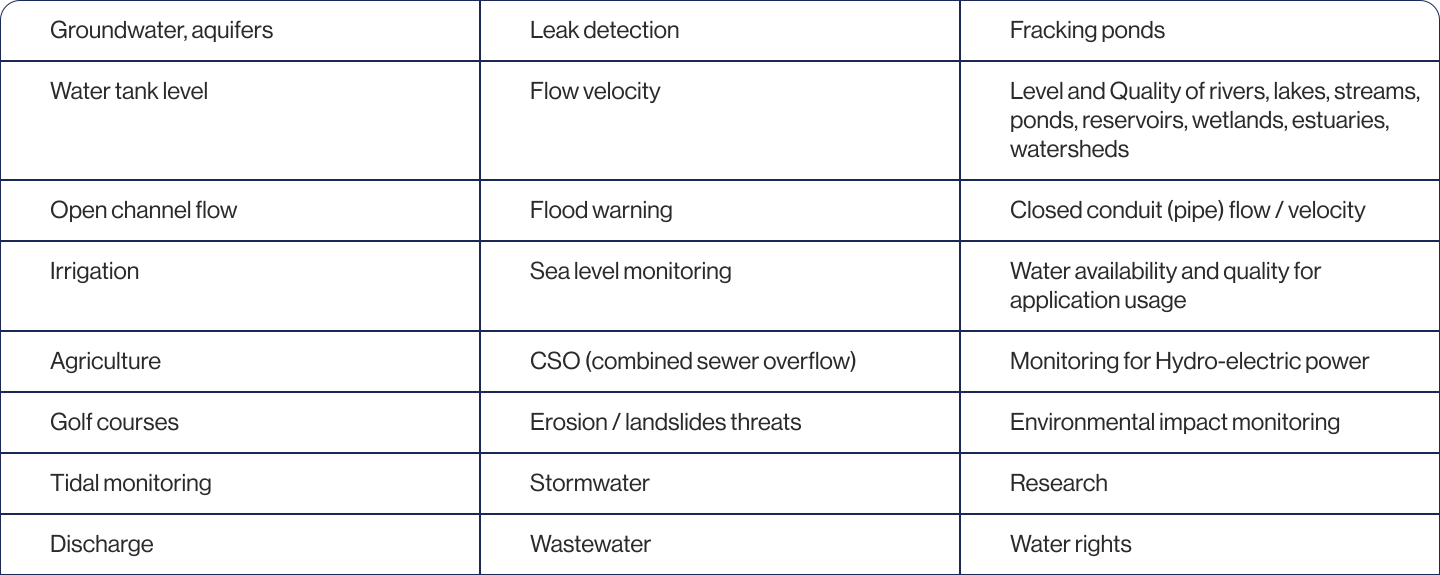
Stevens delivers an integrated environmental measurement platform that connects weather, soil, and water data into defensible, decision-ready insight. Stevens provides field-proven water resource monitoring solutions for measuring surface water, groundwater, and watershed conditions, and that integrates seamlessly with soil and weather monitoring programs. Supporting flood management, water supply planning, irrigation districts, agriculture / turf, and environmental compliance.
Applications
Sensor Measurements
Pressure Sensors
Pressure sensors measure the hydrostatic pressure of the water above the sensor’s diaphragm to calculate the liquid level. External variables that influence the measurements are atmospheric pressure, temperature, water density, and gravity (all that can be compensated for)
Non-contact level sensor
measures the level without physically touching it. Commonly ultrasonic, radar (microwave), or laser faced toward the surface and calculates the level based on the time or phase shift of the reflected signal.
Staff Gages
Staff gages provide quick and easy visual water / liquid levels and are commonly used as reference benchmarks to calibrate water level sensors along a river, channel, reservoir, or structure
Open channel water flow
This is the volume of water moving through channels such as rivers, streams, canals, and flumes. typically calculated by measuring water level and applying a known discharge relationship, or by using velocity-based methods that account for channel geometry and flow conditions.
Water Quality
Water quality measurements assess the physical, chemical, and sometimes biological characteristics of water to determine its suitability for environmental, agricultural, industrial, and human uses.
Chart Recorders
A chart recorder is a mechanical or electromechanical device that provides a continuous, visual record of level over time by marking measurements on a rotating paper chart that offer an immediate historical view of water level trends

Get daily updates
Company
- Home
- About Us
- History
- Conferences & Events
- Distributors
- Join our Team
- Client Profiles
- Contact Us
- Blogs / Articles
Applications
- Soil Monitoring & Soil Hydrology
- Water Monitoring & Management
- Weather & Microclimate Monitoring
- Energy & Industrial Monitoring
Products
- Water Sensors
- Soil Sensors & Measurements
- Weather Sensors
- Data Management Software
- Staff Gage
- Power & Accessories
Follow Us
- X
- Youtube